Cantilevers are common in Calgary. They’re the portions of a house that extend past the foundation — often used to add a bit more floor area, improve natural light, or capture a better view without changing the footprint on the ground.
On their own, cantilevers are often permitted to project into side yards. The trouble starts when you add one more layer on top: generous eaves or soffits projecting from an already‑projecting wall. That’s a projection on top of a projection, and it’s where we often see bylaw problems show up on Real Property Reports (RPRs).

“Those Eaves Look a Bit Close…”
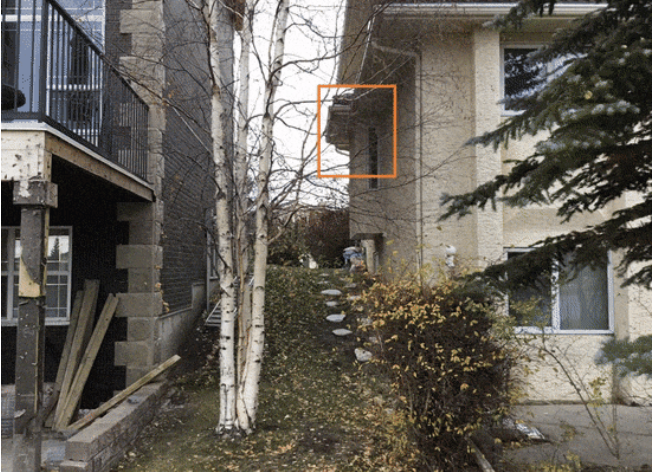
From the street, this Calgary house looked typical: a side‑yard cantilever extending over the foundation, with large eaves built out over top. Nothing seemed unusual to the untrained eye.
On closer review, the cantilever itself had been properly permitted. The real issue was with the eaves on that cantilever. When we completed the RPR, the measurements showed that the eaves were projecting so far into the side yard that they were within 3 cm of the neighbour’s property.
In other words, the permitted cantilever was fine – but the added eaves turned a compliant detail into a potential encroachment and setback problem.
What Our RPR Showed
The RPR clearly illustrated three important things:
- The cantilever location relative to the side property line.
- The additional projection of the eaves beyond the cantilever wall.
- How little clearance was left before crossing onto the neighbour’s lot.
For the buyers and their realtor, this raised obvious questions:
Are the eaves allowed to project that far?
Is this an encroachment or just tight, but legal?
Will the City issue compliance, or is there a risk of a rejection notice requiring resolution before closure?
Because the RPR documented exact dimensions, the City had what it needed to assess the situation and apply the relevant rules.
How It Was Resolved
Once the survey was complete and the RPR submitted, we worked through the permitting and compliance process on our client’s behalf.
The City of Calgary reviewed the original permission for the cantilever, the current regulations for projections into side yards, and the specific clearance between the eaves and the property line.
Upon reviewing the plan[MS1] , the City identified that a development permit — for the purpose of bylaw relaxation — was required for the existing eaves before compliance could be issued. At that point, we helped the seller apply for the permit.
The City approved the relaxation and then issued a compliance certificate. By the end of the process, the prospective buyers knew exactly what they were purchasing, and the sellers had municipal confirmation on file.
Key Rules Around Residential Cantilevers and Eaves
For low‑density residential properties in Calgary, a few recurring rules are especially important:
- Setbacks still apply. Cantilevers must not violate minimum side setback requirements in low‑density districts.
- Projections into side yards are regulated. Certain cantilevers (e.g., bay windows, floor extensions) may project into the side setback, but only under specific conditions, such as requiring a minimum height above grade (often around 2.4 m) and limits on how close they can come to the property line.
- Accessory buildings need clearance. Second‑floor cantilevers, bay windows, and similar features on garages and other accessory buildings must typically maintain at least 1.0 m of horizontal clearance from the main house.
- No cantilevers on corners. Cantilevers are not permitted on the corner of a home due to structural and safety requirements.
- Watch for utilities. A cantilever (or its eaves) cannot project over a gas meter or shut‑off – that’s both a safety and access issue.
You can’t simply keep building “out” over the side yard and hope it’s fine. Each added projection is subject to its own rules.
Practical Takeaways for Realtors and Homeowners
- A “normal‑looking” cantilever can still hide a problem if the eaves are oversized.
- The RPR is often the first time anyone measures how close those projections actually are to the property line.
- Even when something is tight, it may still be resolvable through a development permit and/or compliance review. But that process takes time, so early detection is critical.
If you’re listing or buying a home with a side‑yard cantilever and generous eaves, don’t assume it’s fine just because “everyone in the neighbourhood builds that way.” An up‑to‑date RPR and a clear compliance outcome is the only reliable way to know where you stand.
For help with your property compliance and land use needs in Calgary, trust an experienced Alberta surveyor who knows the stakes. Contact Third Rock Geomatics today!