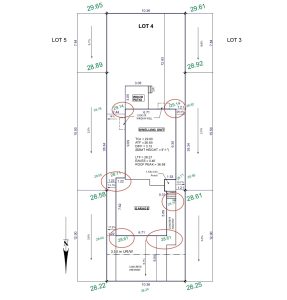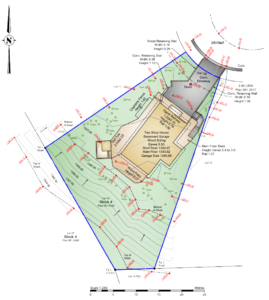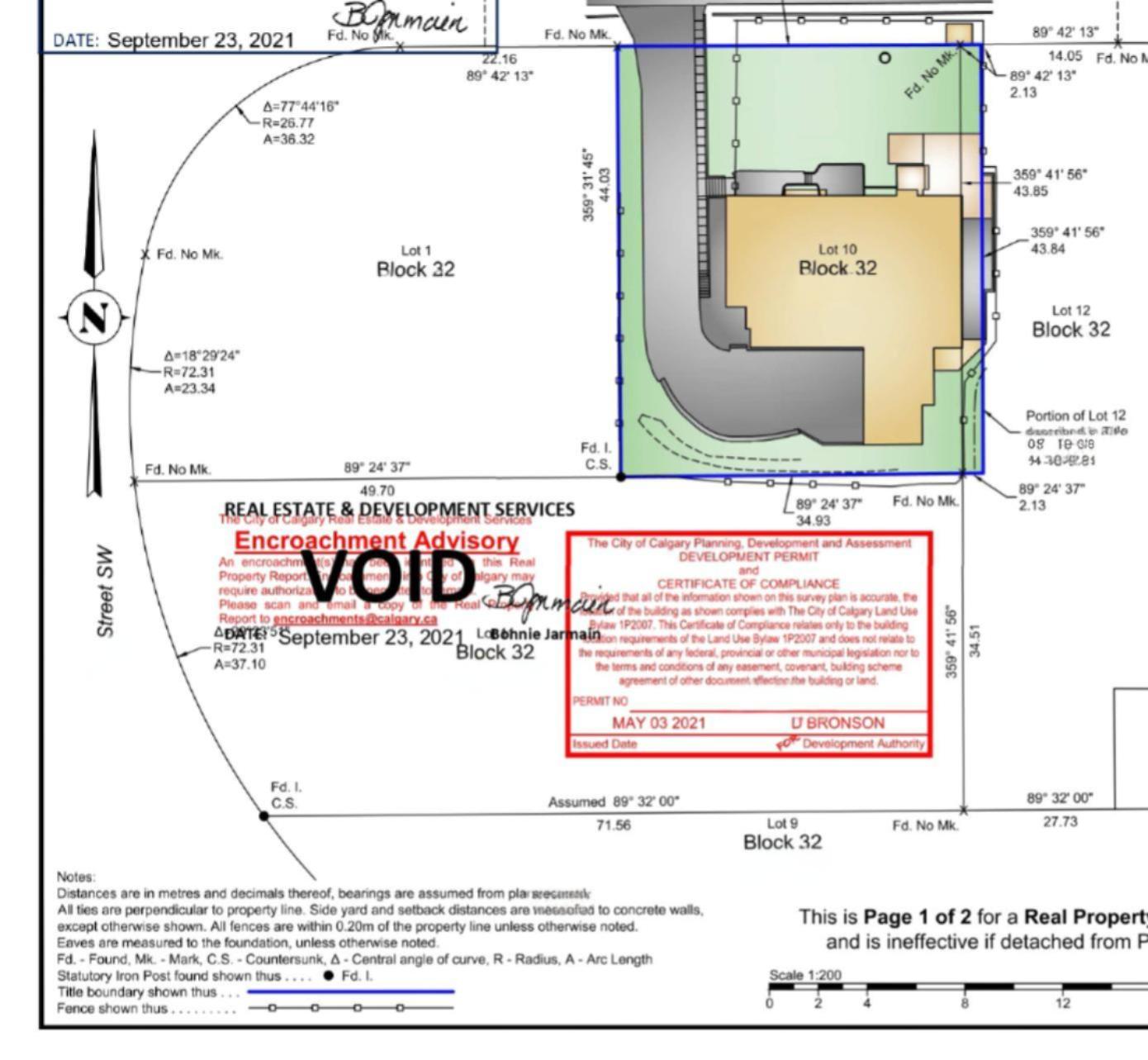
When a property has one encroachment agreement on title, most people already feel a bit uneasy. In this case, there were two separate encroachment agreements attached to the same parcel—one with the City of Calgary and one with the neighbour next door. The question from the realtor was simple, but important:
“Do they need a new RPR if the old one doesn’t show everything that’s now on title?”
This case study walks through what we found and why it matters for anyone relying on an older Real Property Report.
The Scenario
A realtor wrote to Mark Sutter about a client who was about to sell their house. When they pulled title, they noticed there were two different encroachment agreements tied to the property:
1. An encroachment agreement with the City of Calgary
- Registered by caveat against the owner’s lot.
- The City granted the owners the right to continue an encroachment onto a City right‑of‑way / easement, as long as they met the conditions in the agreement.
- The City’s caveat explicitly referenced an attached Real Property Report as Schedule A, showing the encroachment in relation to the City parcel.
2. A private encroachment agreement between neighbours (brick retaining wall)
- Between the owner of Parcel “A” and the owners of Parcel “B.”
- A brick retaining wall built on Parcel A encroaches up to 0.28 m onto Parcel B, as shown on Schedule “A” to that agreement.
- The agreement gives Parcel A the right to maintain the encroaching portion of the wall on Parcel B, with indemnities and caveats that may be registered on both titles.
The Catch
Both agreements were properly registered on title. However, only the City encroachment was reflected in the RPR the seller hoped to reuse.
The private neighbour‑to‑neighbour encroachment agreement was not shown on that RPR, even though it affected the same lot the buyers would be acquiring.
Does the Old RPR Still Work?
Mark’s answer to the realtor was clear:
“If a Real Property Report is meant for a purchaser to rely on for the purposes of understanding all the rights and interests associated with the parcel of land, the Real Property Report should show the interest associated with the [private encroachment agreement].”
Even if nothing physical has changed on the ground, the RPR may still be deficient if:
- It doesn’t reflect all current registered interests on title (in this case, the neighbour’s encroachment agreement), and
- A purchaser could reasonably expect to see those interests illustrated or referenced on the plan they are being asked to rely on.
Lawyers use both title and the RPR to explain rights and interests to their clients. If a buyer’s lawyer notices that title shows an encroachment agreement which the RPR does not illustrate, they are much more likely to reject the RPR than ignore the title entry.
Title is the guaranteed document. It carries more legal weight than an older RPR that doesn’t fully match it.
Mark’s practical suggestion to the realtor:
“If time is a concern or hold backs are a concern, I would suggest the land owner have an updated RPR ready to hand over to a purchaser.”
Why This Matters for Realtors and Lawyers
This case highlights a few important points:
- Two different encroachments, two different agreements.
One with the City (onto a City right‑of‑way/easement) and one private encroachment (a brick retaining wall from the neighbour). Both affect how the land can be used and who is responsible for what.
- Title can change even when the yard doesn’t.
Encroachment agreements can be registered years after the original RPR was prepared. If you rely on an old RPR without checking whether new encroachment agreements have been added to title, you can miss critical information.
- A “clean looking” yard doesn’t mean a “complete” RPR.
The physical situation might look unchanged, but the legal picture has evolved. Buyers and their lawyers will care about all encroachments and agreements—not just the ones that appear on an older plan.
- RPR + Title must tell the same story.
When they don’t, the safest course is usually to update the RPR so the plan and the title match. That’s often the difference between a smooth closing and last‑minute conditions, holdbacks, or a rejected document.
Key Takeaways
- If a property has one or more encroachment agreements on title, check carefully whether they are all shown or referenced on the current RPR.
- An RPR is not “wrong” simply because title has changed—but it may no longer be adequate for a new purchaser to rely on.
- When in doubt, especially where multiple encroachments are involved, ordering an updated RPR before listing or early in the deal gives everyone more time and fewer surprises.
For help with encroachment agreements and bringing your RPR in line with title, trust an experienced Alberta surveyor who knows the stakes. Contact Third Rock Geomatics today!